The Cleveland Museum of Art
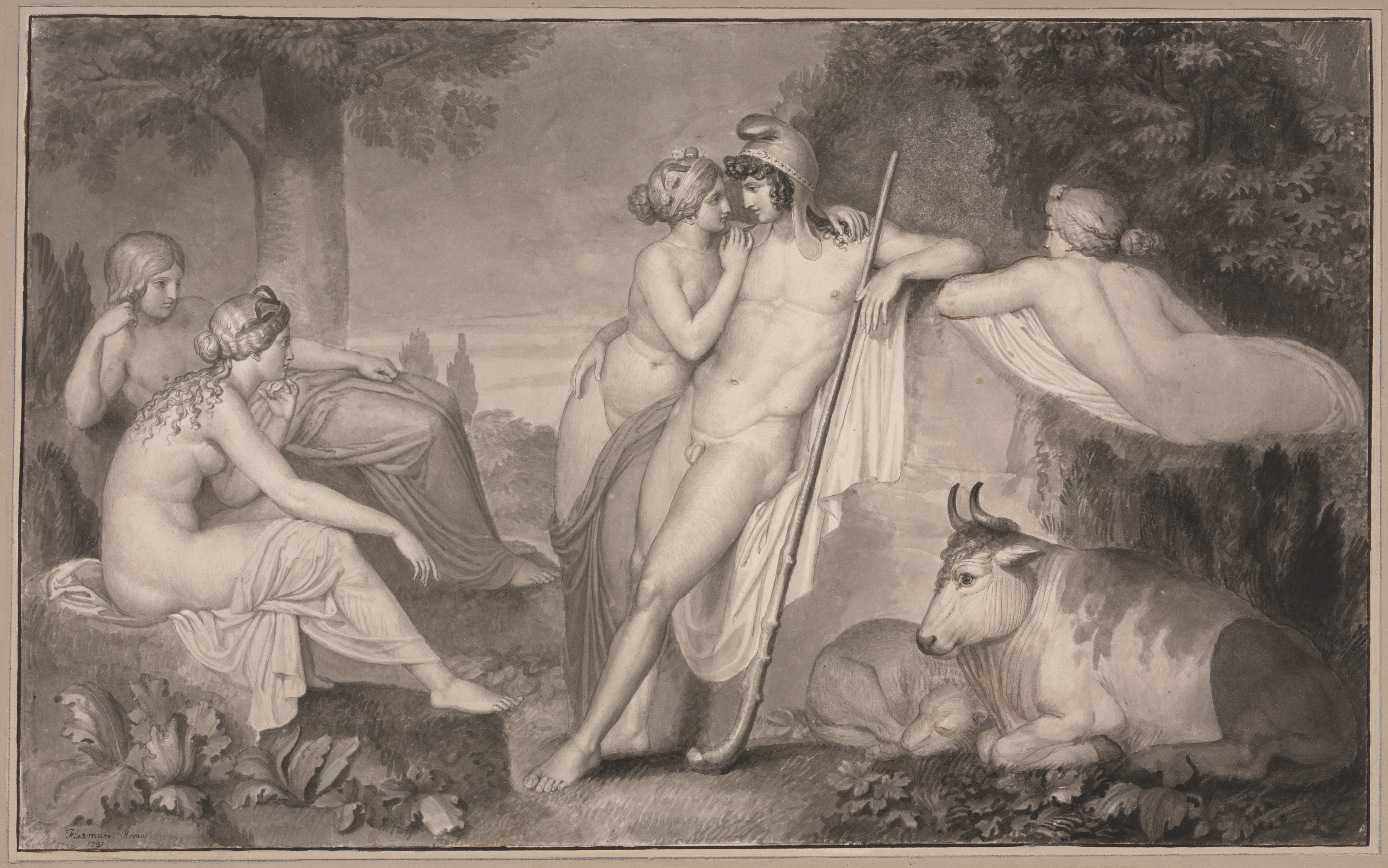
Paris and Oenone
Description
Although he identified himself first and foremost as a sculptor, John Flaxman’s greatest fame and most lasting influence rest with his drawings. Engravings made after his spare designs illustrating classical epics by Homer, Dante, and Hesiod became the most celebrated work in his oeuvre and spread his stylized linearity widely. This highly finished, signed and dated drawing was made while Flaxman was in Rome and needed to supplement his income while trying to obtain commissions for sculpture. Flaxman chose an obscure classical subject: the famous Trojan shepherd, Paris, with his first love, the nymph Oenone. The scene takes place on Mount Ida, in an idyllic time of peace before Paris was called upon to judge the beauty of the goddesses Hera, Athena, and Aphrodite, thus instigating the Trojan War.
Provenance
Marquis de Lagoy [1764-1829; L. 1710]; By repute, from a member of the William Randolph Hearst family; (Alexander Acevedo, Alexander Gallery, New York, NY); Private Collector, New York, NY; (Monroe Warshaw, New York, NY, sold to the Cleveland Museum of Art, Cleveland, OH); Cleveland Museum of Art, Cleveland, OH
Dimensions
30.3 × 48.8 cm
Movement / Period
Accession No
2008.35
Official Citations
Curatorial Affinity Stream
Continuing the Universe of John Flaxman (British, 1755–1826)
Drawings • England, 18th century • Harmonious Works & Contemporaries
Continuous Discovery