Description
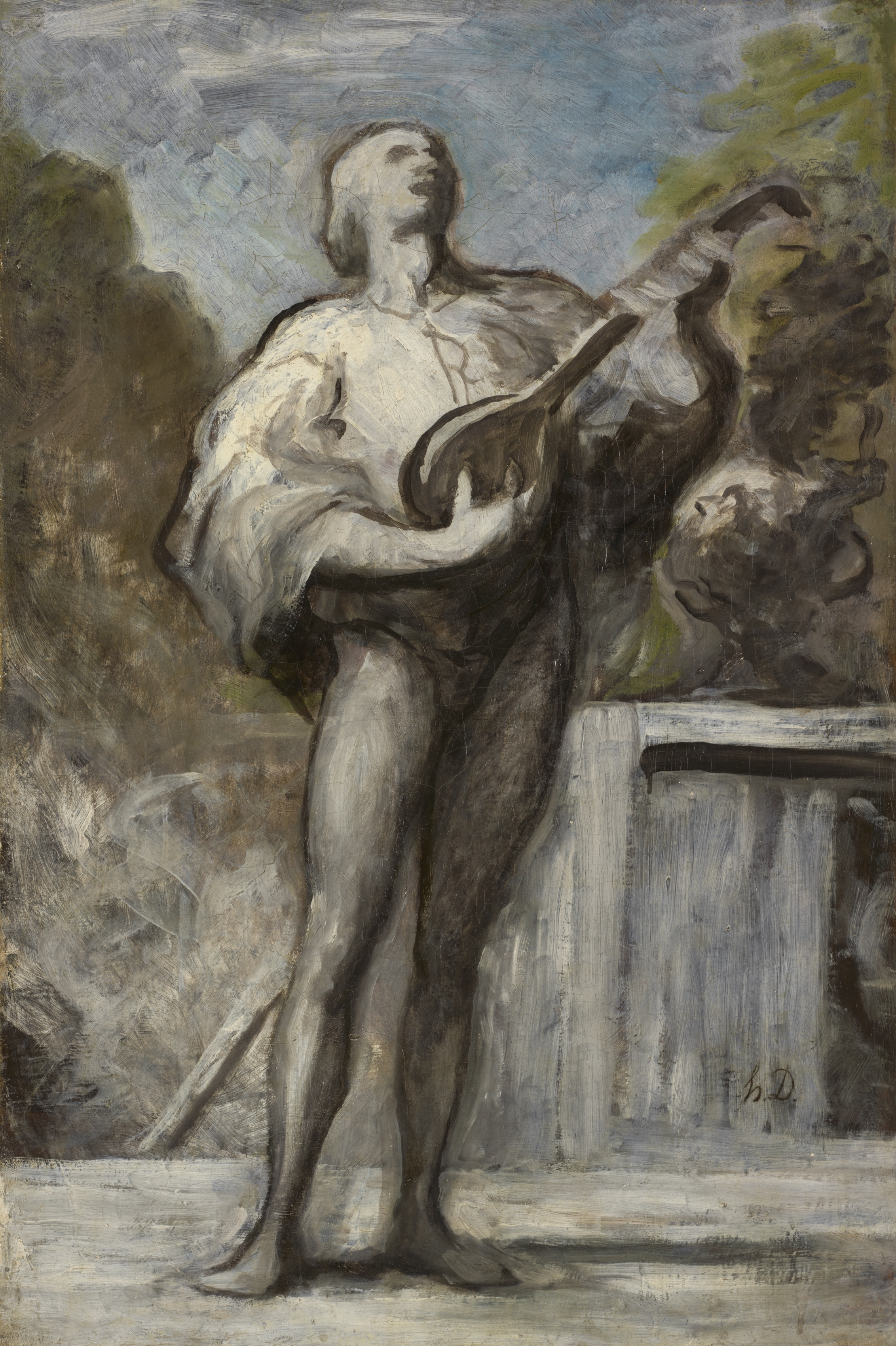
The troubadour, a medieval traveling poet and entertainer, was a popular subject in 19th-century French art. Associated with chivalry and courtly love, the theme reflects a broader, romantic fascination with France's medieval past. Although Daumier was particularly inspired by the troubadour paintings of French Rococo artist Jean-Antoine Watteau of the 1700s, he rendered the subject here in a powerful style of simplified, muscular form that appealed to modern artists of his own time.
Provenance
Count Armand Doria [1824-1896] Orrouy, France; (Armand Doria sale, Galerie Georges Petit, Paris, May 4-5, 1899 (no. 132), sold to Ambroise Vollard); (Ambroise Vollard, Paris, sold to Paul Cassirer); (Paul Cassirer, Berlin); Eduard Fuchs [1870-1940], Berlin-Zehlendorf, by descent to his wife, Margaret Fuchs; Margaret Fuchs, Paris and New York, consigned to Justin K. Thannhauser; (Justin K. Thannhauser, New York, sold to Leonard C. Hanna, Jr.); Leonard C. Hanna Jr., [1889-1957], Cleveland, OH, bequeathed to the Cleveland Museum of Art; The Cleveland Museum of Art, Cleveland, OH
Dimensions
83.6 × 56.8 cm
Movement / Period
Accession No
1958.23
Official Citations
Curatorial Affinity Stream
Continuing the Universe of Honoré Daumier (French, 1808–1879)
Modern European Painting and Sculpture • France, 19th century • Harmonious Works & Contemporaries
Continuous Discovery