The Cleveland Museum of Art
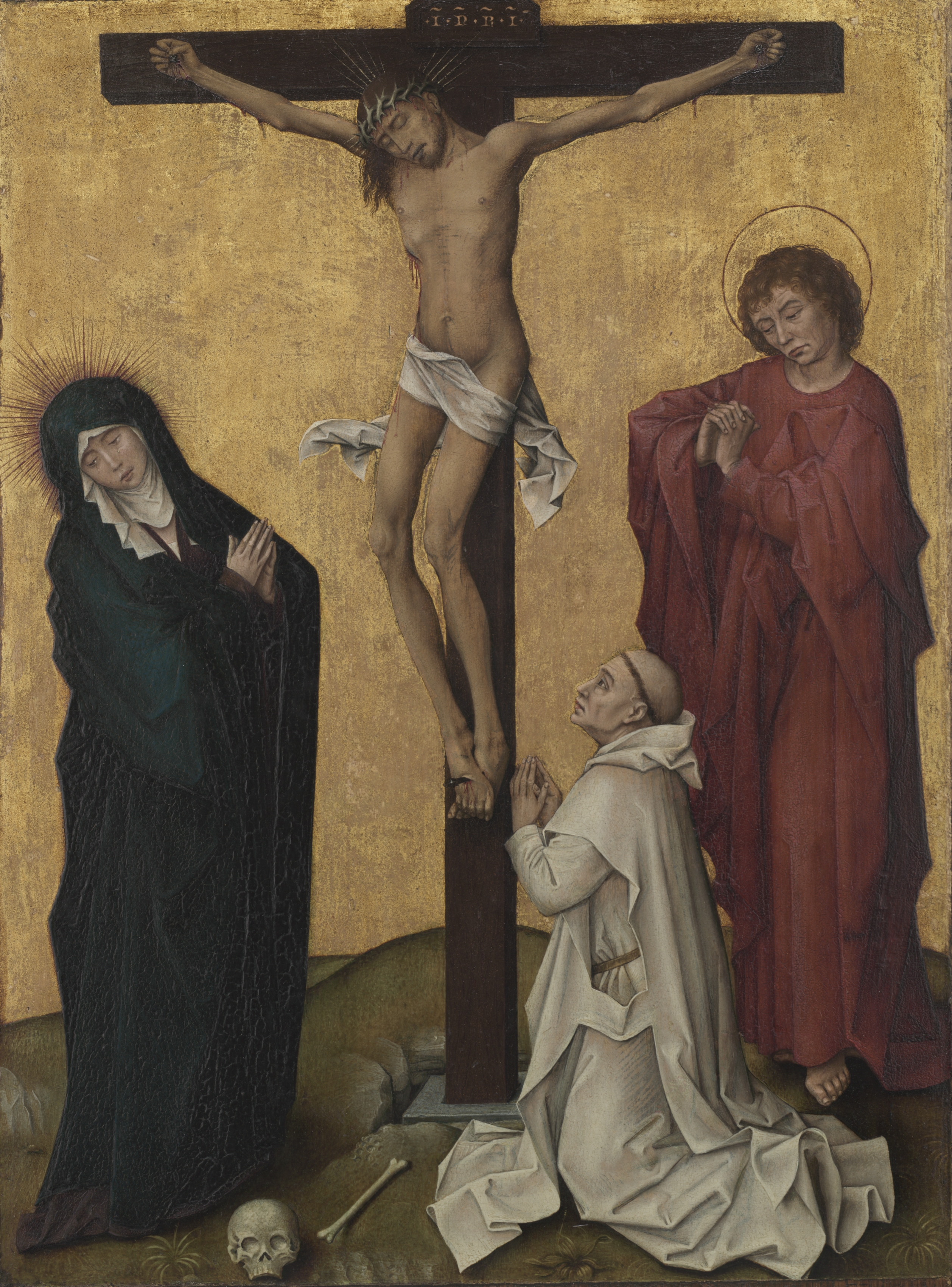
The Crucifixion with a Carthusian Monk
Description
This painting shows a Carthusian monk kneeling in devotion and prayer before the Crucifixion. It is likely that this panel was intended for the cell of a monk in an unknown monastery. The Carthusians were particularly devoted to the Passion and Crucifixion of Christ, and devotional images were provided for each monk’s cell. The Carthusian order was founded by Saint Bruno in 1084 with the purpose of providing the strictest separation from the world. The first Carthusians were dedicated to contemplation through silence, prayer, poverty, penance, and almost continuous occupancy of a solitary cell. The solitary life could only be maintained through the establishment of separate cell houses. Each community of monks was limited to the apostolic number of 12, though exceptions were sometimes made. They were recognized by their white, full-length, cowled habit called the scapular, shown here. The artist has not been identified.
Provenance
Private Collection, Lower Rhine, Germany; (Paul Drey, Munich, Germany); (A. S. Drey, New York, NY sold to the Cleveland Museum of Art); The Cleveland Museum of Art, Cleveland, OH
Dimensions
38.4 × 29.2 cm
Movement / Period
Accession No
1931.449
Official Citations
Curatorial Affinity Stream
Continuing the Universe of Rogier van der Weyden (Flemish, c. 1399–1464)
Medieval Art • Netherlands • Harmonious Works & Contemporaries
Continuous Discovery