Interactive Gigazoom • Scroll or Double-Click
100%
The Cleveland Museum of Art
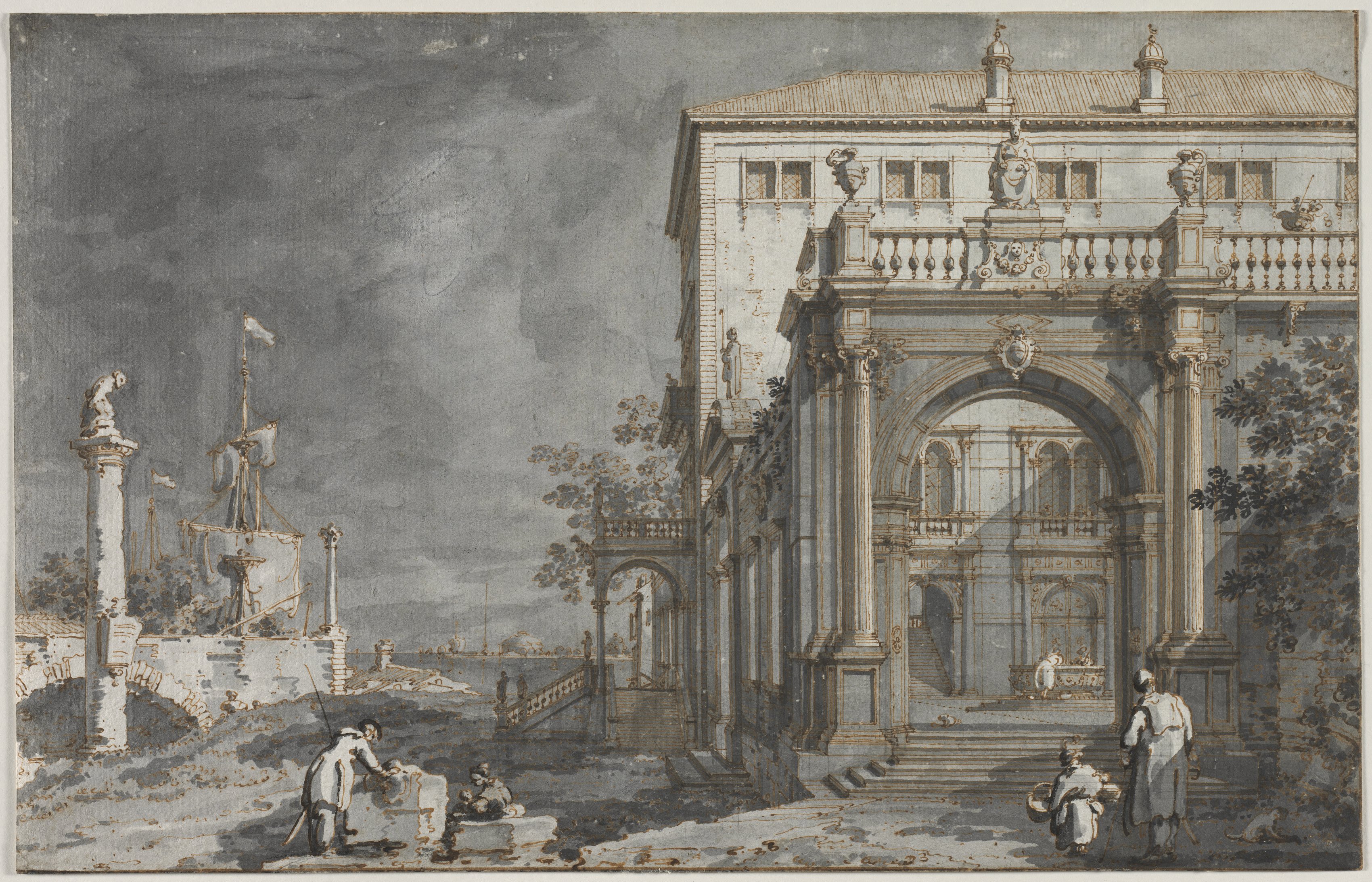
Capriccio: A Palace with a Courtyard by the Lagoon
Description
Privileged young Europeans embarking on the Grand Tour during the 1700s invariably visited Venice, where they purchased paintings, prints, and drawings to commemorate their trip. Canaletto’s vedute (view paintings) were particularly desirable as mementos of the city. This drawing is a capriccio—an artistic fantasy of architecture and landscape. Canaletto often referred to actual buildings in his capricci, manipulating and combining them to create his invented views. The palatial structure in this composition appropriates the neo-Palladian portal to the Palazzo Tasca in Venice; however, the lagoon, peasant figures, and architectural details are artifice. Traces of Canaletto’s graphite underdrawing are visible in the cloudy sky, as are the black chalk lines he carefully ruled in before delineating the building with pen and brush. The brown ink outlines of the composition contrast with Canaletto’s tints of transparent gray wash, which animate the drawing through their effect of flickering sunlight. Though three large, painted capricci paintings share compositional elements with this drawing, it is unclear whether it is a preliminary study, or an independent work of art.
Provenance
(Obach & Co. (est. 1884), London, sold to Dr. Guy Bellingham Smith.); Dr. Guy Bellingham Smith [1856-?], London, UK.; (Frederik Muller & Co., Amsterdam, sold July 6, 1927, cat. no. 9.); (Thomas Agnew and Sons (est. 1817), Ltd., London, UK, sold to The Cleveland Museum of Art, Jan. 1930.); The Cleveland Museum of Art, Cleveland, OH.
Dimensions
26.9 × 42.1 cm
Movement / Period
Accession No
1930.23
Official Citations
Curatorial Affinity Stream
Continuing the Universe of Antonio Canaletto (Italian, 1697–1768)
Drawings • Italy, Venice • Harmonious Works & Contemporaries
Continuous Discovery