Gigazoom • Double-Tap or Pinch to Zoom
100%
Curatorial Overview
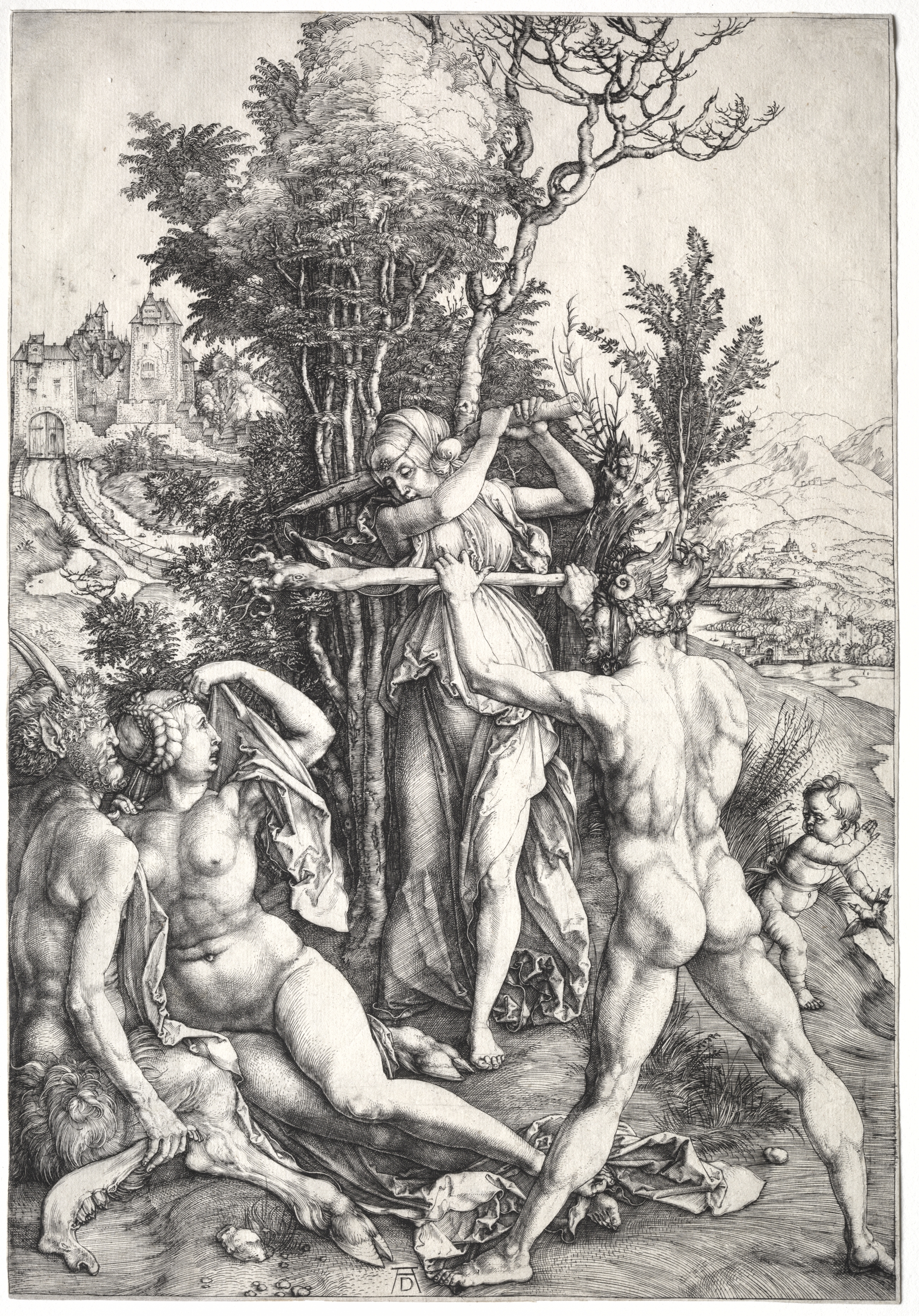
“In his journal, Albrecht Dürer referred to this enigmatic engraving as “the Hercules,” but the image is not a typical representation of the mythological hero’s 12 labors. The subject derives from a Greek parable, where Hercules decides between a life of pleasure or one of virtue. The moral dispute plays out here as a battle between two personifications, Virtue, wielding a club, and Pleasure, lying with a satyr. Hercules’s crossroad is a copse of trees between two paths: the ascent to civilization at left (pleasure?), or the winding river to the wilderness at right (virtue?).”
Mediumengraving
Dimensions{"image":{"height":0.324,"height_inch":12,"height_inch_fraction":0.75,"width":0.222,"width_inch":8,"width_inch_fraction":0.75},"sheet":{"height":0.324,"height_inch":12,"height_inch_fraction":0.75,"width":0.222,"width_inch":8,"width_inch_fraction":0.75}}
OriginGermany, late 15th-early 16th century
InstitutionThe Cleveland Museum of Art
Accession No.1961.170
Credit LinePurchase from the J. H. Wade Fund
In This Series & Related Works
More by Albrecht Dürer
Curatorial Affinity Stream
Continuing the Universe of Albrecht Dürer (German, 1471–1528)
Prints • Germany, late 15th-early 16th century • Harmonious Works & Contemporaries
Continuous Discovery